Friday, 21 October 2011
Starting a new school year
Hello everybody!
It's been a long time since the last time I wrote here! Time goes by so fast...
We have already started with new activities for our eTwinning project: the first one is a short video presenting yourselves, and the Spanish students have created some very original presentations. They are already on our Twinspace, and I encourage you to watch them and leave a comment with your opinions.
I hope you will like them!!!
Warm regards from Vinaròs
Friday, 3 June 2011
Retezat
We went on a trip to the Retezat Mountains, the most beautiful and amazing in the Southern Carpathians. Retezat is also called "the blue-eyed mountain", as there are about 80 glacier lakes. The largest of them are Bucura and Zănoaga. We spent three days in the Retezat National Park, taking part in different activities like: hiking, tourist orientation, rope activities(tiroliana), outdoor games, teambuilding, firecamp, guitar songs, etc. Although this place is very close to our town, it seems so far away. You've got the feeling that time has stopped.
Enjoy the video!
Saturday, 14 May 2011
Best of Poland (our trip to the south - west of Poland)
We would like to drop some lines about our 3 days trip to one of the most beautiful part of our country called Kotlina Kłodzka, on the border with Czech Republic. We spent there 3 days, we stayed in an old hotel 2 nights. The sun were shining all 3 days. It was very hot. We were climbing to the top in the mountains, we were going down to the Golden mine in Złoty Stok (złoty means golden), we were drinking water on the oldest Polish spa. What is interesting Lower Silesia was part of Prussia, Austria and Czech Kingdom. We prayed in the sanctuary Wambierzyce (ALbendorf). We didn't sleep a lot at night. It was exciting we had fun and enjoyed very much. Greeting from Poland
Let's have a look at some pictures in "Holidays in our countries"
Polish students from Rybnik
Friday, 13 May 2011
Day of Europe!
In our school we also celebrated the Day of Europe, as you can see in these photos.
Thursday, 21 April 2011
Easter eggs from Poland
Pictures comes from nowiny.pl
Happy Easter to every member of our project!
Wednesday, 20 April 2011
WET MONDAY at EASTER in POLAND
Smigus Dyngus and other Polish old Easter Traditions
Smigus Dyngus (shming-oos-ding-oos) is an unusual tradition of Easter Monday. This day (Monday after Easter Sunday) is called also in Polish "Wet Monday", in Polish: "Mokry Poniedzialek" or "Lany Poniedzialek". Easter Monday is also a holiday in Poland. It was traditionally the day when boys tried to drench girls with squirt guns or buckets of water. "Smigus" comes from the word smigac meaning swish with a cane since men tap the ankles and legs of the girls. Dyngus comes probably from German word dingen which means to come to an agreement since the girls needed to give men money to stop being swish and splash. The more a girl is sprayed with water, the higher are her chances to get married. Usually groups of young boys are waiting for accidental passerby near the farmer markets or in the corners of the streets. Older men behave like gentlemen spraying their wives with cologne water rather than with the regular one. The girls got their chances for revenge the following day. They can spray boys with water as much as they wanted on Tuesday.
Dousing may have pagan roots, or it may reflect Christian rebirth and baptism. It may hark back to the baptism of Poland's Mieszko I and his court on Easter Monday in 966. Whether the tradition is historic or religious in origin, Smigus-Dyngus remains a significant, well-loved Polish tradition.
American Polonia descendants of the 1890s-1930s immigration often celebrate Dyngus Day with a polka dance.
http://culture.polishsite.us/articles/art31fr.htm
Monday, 18 April 2011
Happy Easter from Spain!!
As Luisa and Marika have already shown their typical traditions during Easter. I am going to show you some of our traditions here in the Valencian Community.
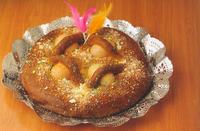
Another typical food is the "farinosa". It is made with the same dough but it is filled with "confitura de cabello de ángel", which is a sort of pumpkin jam. They are rolled and without eggs.
The tradition here is that the godfather or the godmother gives their grandson or granddaughter the "mona" to be eaten during the Easter Sunday with the family or friends. As Easter usually at the beginning of the spring, everybody goes to eat the "mona" to the country, and flying a kite is also a typical tradition.
It is thought that the word "mona" comes from the Arabic word "munna" which means "gift or present". And I have discovered that the eggs and the chicks represent the renewal and the rebirth, the resurrection of Jesus Christ.
I hope you will like all this information about Easter in our region!
Happy Easter!
Sorry...my comments option doesn't work!
Also in Trieste we have similar traditions: we paint the eggs (not as beautiful as your, Marika!) and your Tsoureki is like our sweet leavened bread we call "Titola". It symbolizes the nail of the cross of Jesus. I suppose this similarities are due to the presence of a big Greek comunity in Trieste since 1700. But we have also the chocolate eggs!


And yes, we were in Munich (Germany) with 43 students of the third year of middle school. They are 14 and they study two foreign languages: english and german. And Germany is the nearest country for us! Other classes were in Graz and Wien (Austria) and in Nice and Principality of Monaco (France) because they study French as third language.
Sunday, 17 April 2011
Happy Easter

Tsoureki and red eggs!!!Hello to everybody!
I've had a hard period at school. First of all I was in Munchen with my oldest students for a 5-days trip, and it was really tiring week. We are back home on Friday night and on Monday I left again for a 5-days trip in Torino and Aosta with the middle students. Now I have only two days at school before the Easter holidays but I'm really KO!
And in this period, from March to Easter, all students are involved in theate projects with rehearsal and construction of sets and I've to manage all their movements.
I hope that my students prepare a slide-show of their trips before Easter to share with European friends their findings and feelings.
Ciao
Luisa
Thursday, 14 April 2011
School trip to Italy
Sunday, 3 April 2011
Greece-Spring is here!
Wednesday, 16 March 2011
Tuesday, 8 March 2011
Women's Day
Saturday, 5 March 2011
Thursday, 3 March 2011
Carnaval de Vinaròs
And, if you want to see it, here you are a brief promo of the Carnival of Vinaròs.
We have Carnival holidays from tomorrow, Friday 4th March until next Monday 7th March. I hope my students will show you some pictures of the Carnival events next week.
Tuesday, 1 March 2011
“Mărţişor”

There is an old tradition in Romania to celebrate the 1st of March by offering a tiny gift, called “mărţişor”, as a symbol of the spring to come, to people we care about. It also symbolizes the rebirth of nature. Literally, the word means little March. Nowadays, men offer women such a talisman object, also consisting of a jewel or a small decoration like a flower, an animal or a heart, tied to a red and white string. It is believed that the one who wears the red and white string will be powerful and healthy all year round.
Saturday, 26 February 2011
Greece - Caves
In Greece there are many impressive Caves.
In some of them stalactites and stalagmites
Also in some of them it is neccesary a boat.Tuesday, 22 February 2011
The best of Poland
The first picture represents the european bizon called ŻUBR in Polish. In the coat of Romani you can see the bizon. We have a lot of bizons especially in the forest on the eastern border. But to tell you the truth the european bizons survived in Europe thanks to these animals living in Silesian forests.
Greece - Mycenae
Mycenae is 50km to the South of Corinth.The Lion Gate is the entrance of the Palace of Mycenae.